Full rules
Dead to Rites playtest edition · rules v0.2 · 4 players · 45–60 minutes
Overview
Dead to Rites is a 4-player free-for-all card game. Every player is always racing to finish a 5-step Ritual, and the other three must work together to stop whoever is closest.
- The core tension: blocking the leader costs you cards, which slows your own Ritual. Everyone wants someone else to pay for the block.
- No elimination: a player whose Rite is blocked gets Favor back and draws cards, so nobody is ever out of it.
Components
Each player has:
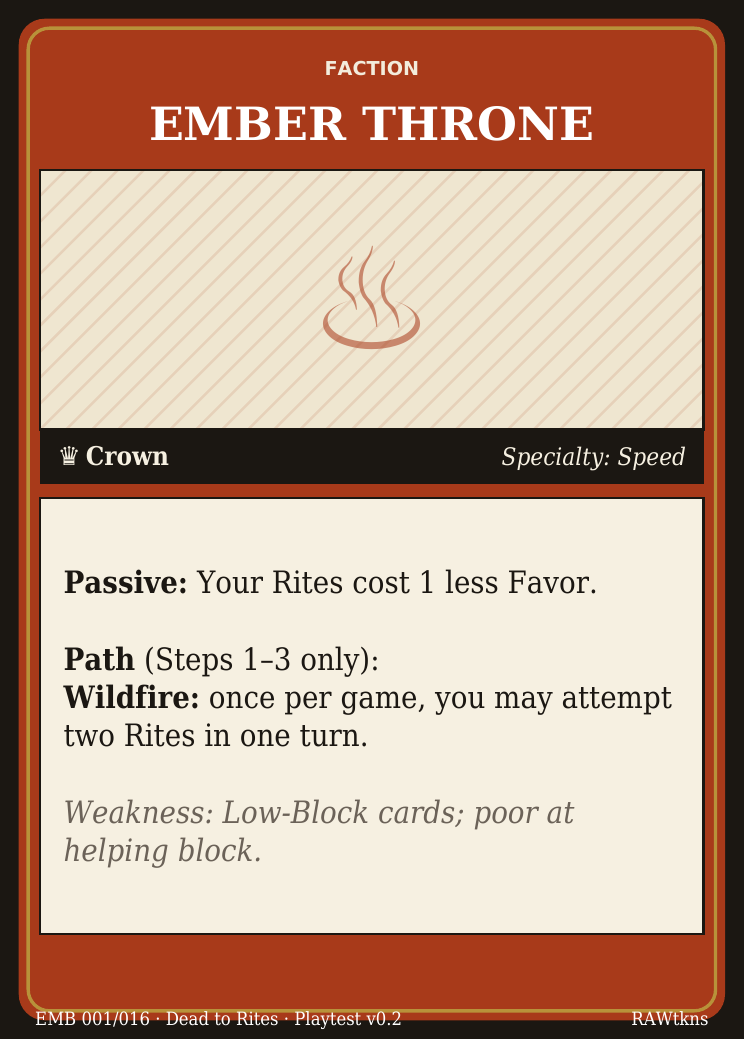
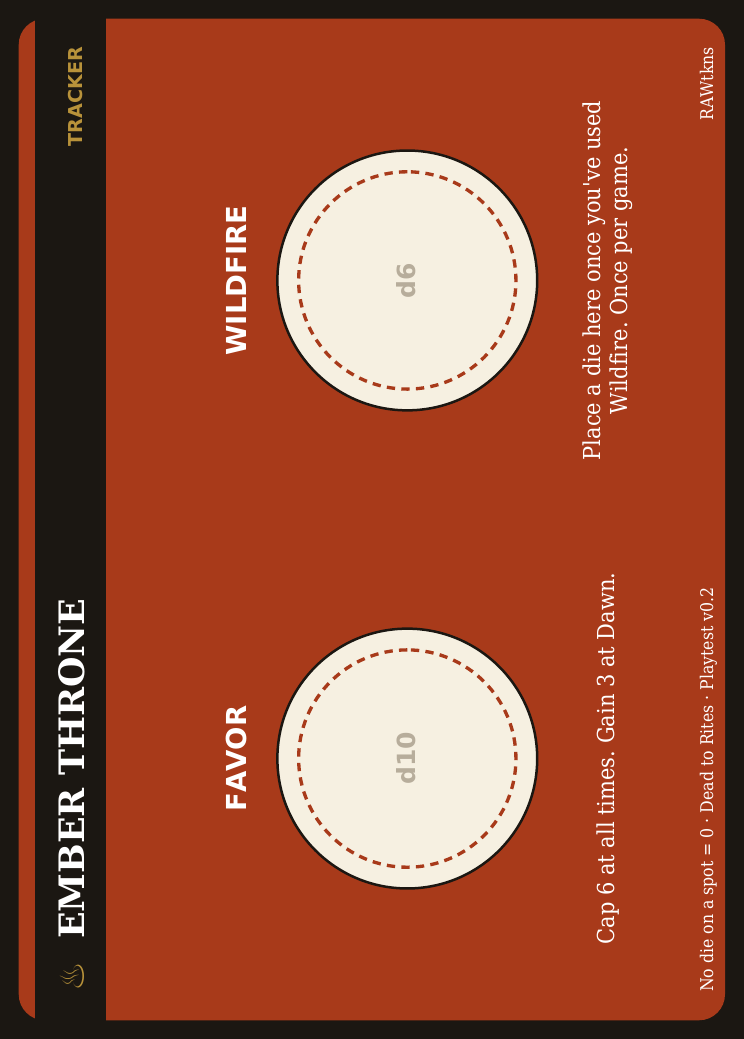
- 1 Crown card: your faction, with its passive ability. It comes with a tracker card for your Favor, plus Secrets, Bonds, Requiem or Wildfire if your Crown uses one.
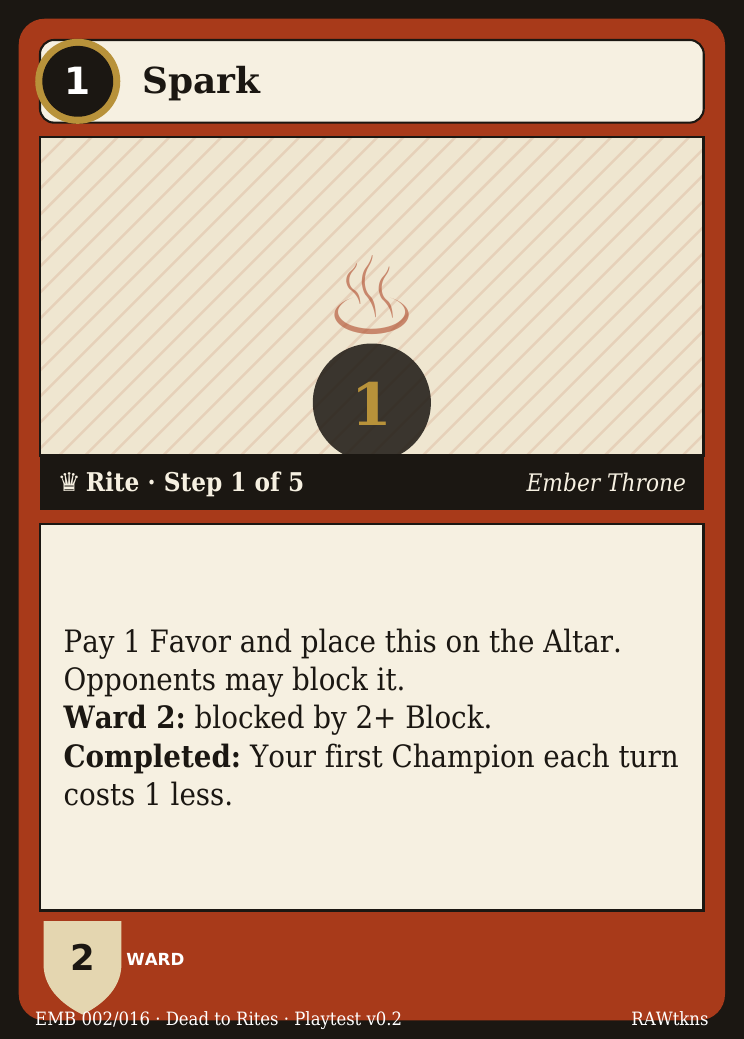
- 5 Rite cards (Steps 1–5): kept face up in order beside your play area, never shuffled into your deck.
- A 40-card main deck: at most 3 copies of any card.
Shared between everyone is the Altar mat: each player's step track (0–5), the Altar where a Rite waits while players respond, and the Defense Pool where opponents commit cards against it.
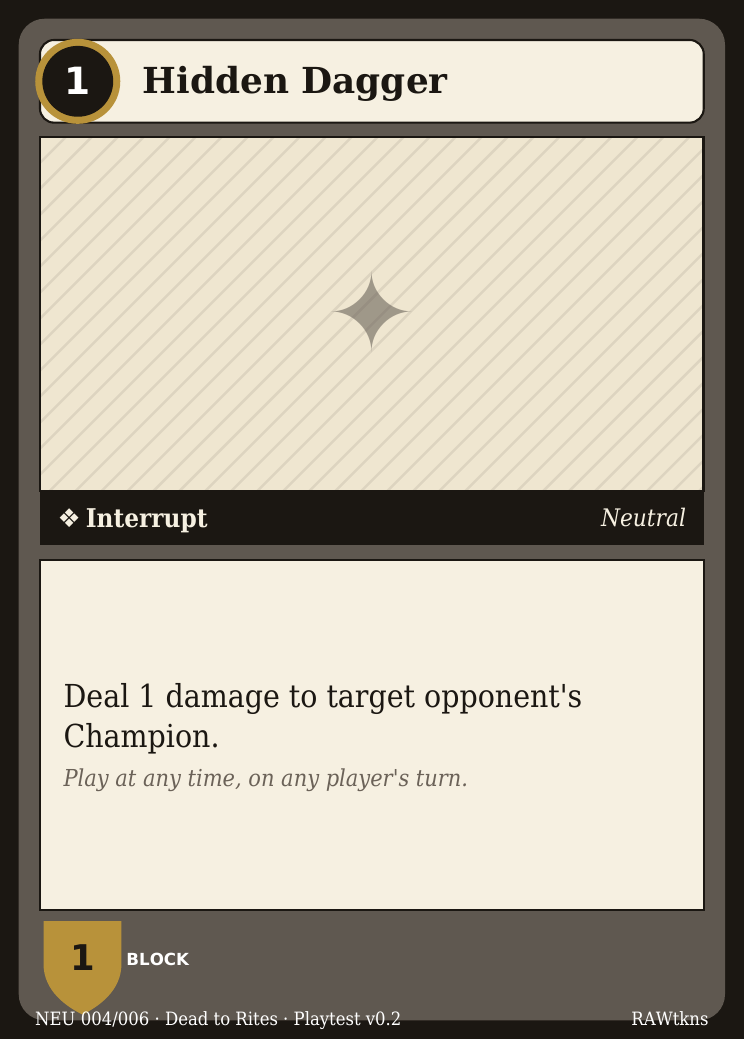
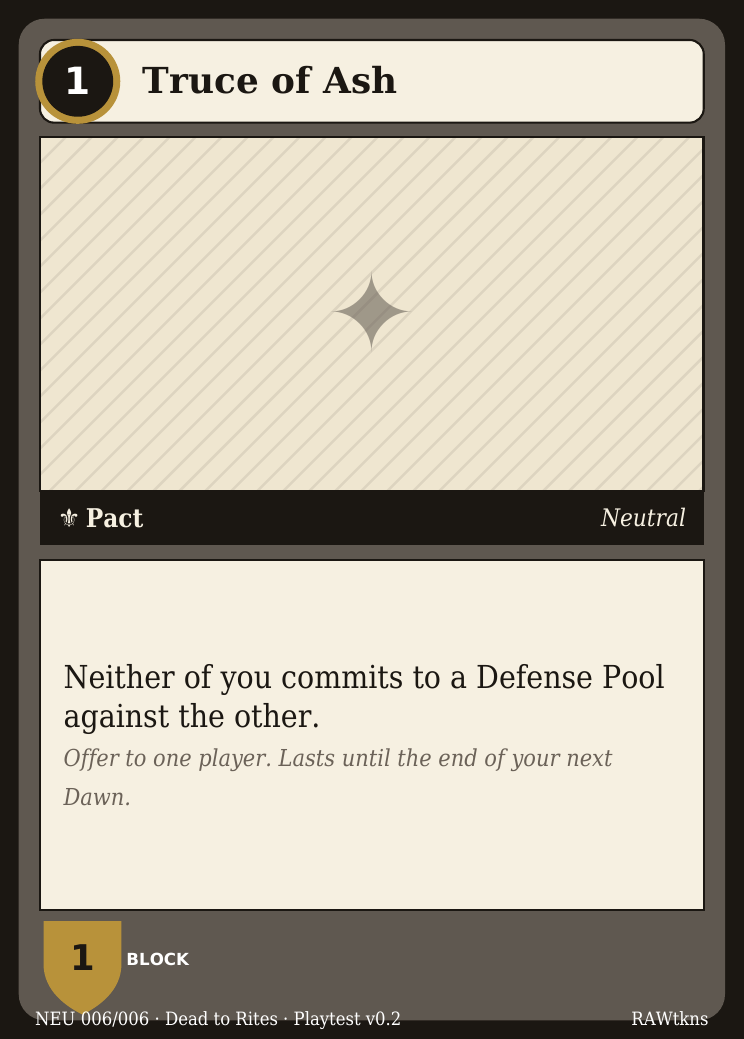
Main deck card types
| Type | When you play it | What it does |
|---|---|---|
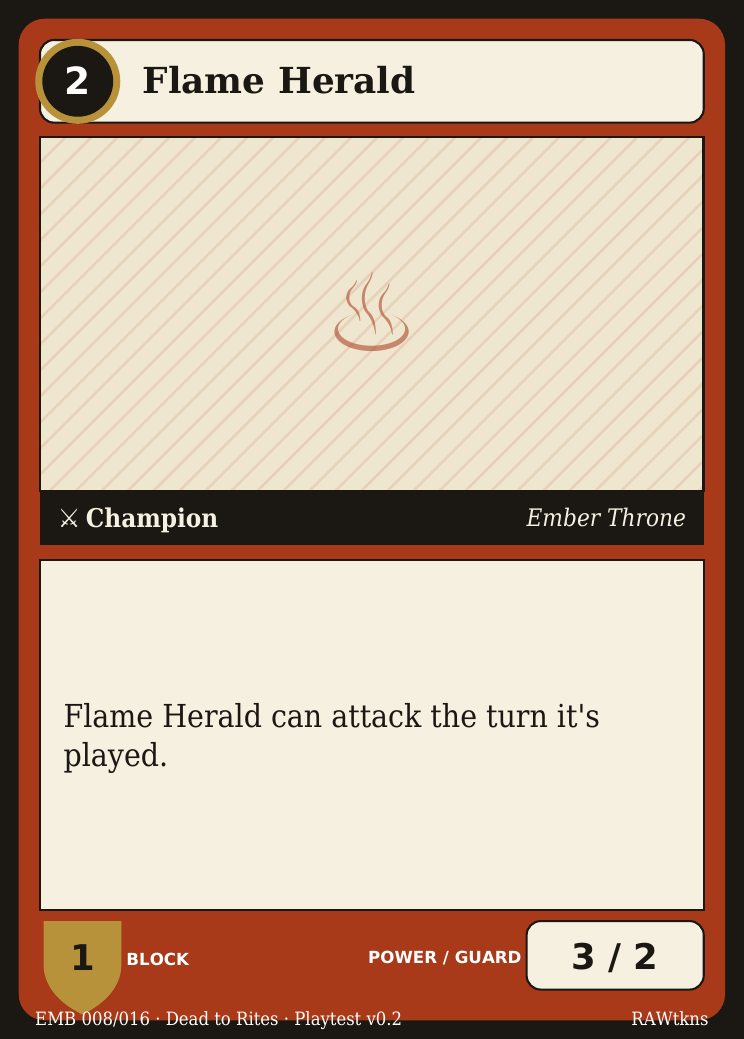
| Champion | Your Main phase | Stays on the table. Adds +1 Ward to your Rites, or attacks other Champions. |
| Tactic | Your Main phase | A one-shot effect, then it's discarded. |
| Interrupt | Any time, on any player's turn | A reaction: block, counter, steal. |
| Pact | Your Main phase | A temporary deal with one other player. |
Block value: every main-deck card has a Block number (0–3) in its corner. Any card can be committed face down to the Defense Pool for that value, so even a weak card still helps stop the leader.
Key terms
- Favor
- The resource you spend to play cards and attempt Rites.
- Power / Guard
- A Champion's attack and toughness, written 3/1 (3 Power, 1 Guard).
- Block
- The number on a card's shield: what it's worth when committed to a Defense Pool.
- Ward
- A Rite's defense: the total Block needed to stop it. Not the same as a Champion's Guard.
- Engaged / ready
- A Champion engages (turns sideways) when it attacks or uses an "Engage:" ability. Engaged Champions can't attack and don't add Ward. Your Champions ready (turn upright) at your Dawn.
- Destroyed
- Put into its owner's discard pile.
- Target
- A card that says "target" makes you choose a player or Champion when you play it. "Target Champion" can be any Champion, including your own; "target opponent's Champion" can't be yours. If the target is gone or can't be targeted when the card resolves, that part does nothing. Attacks aren't cards, so a Champion that can't be targeted can still be attacked.
- Counter
- Cancel a card. It has no effect, goes to the discard pile, and its cost isn't refunded.
- Expel X
- Put the top X cards of your deck into your discard pile.
- Poison
- A keyword on some Champions. Damage they deal doesn't clear at Dusk.
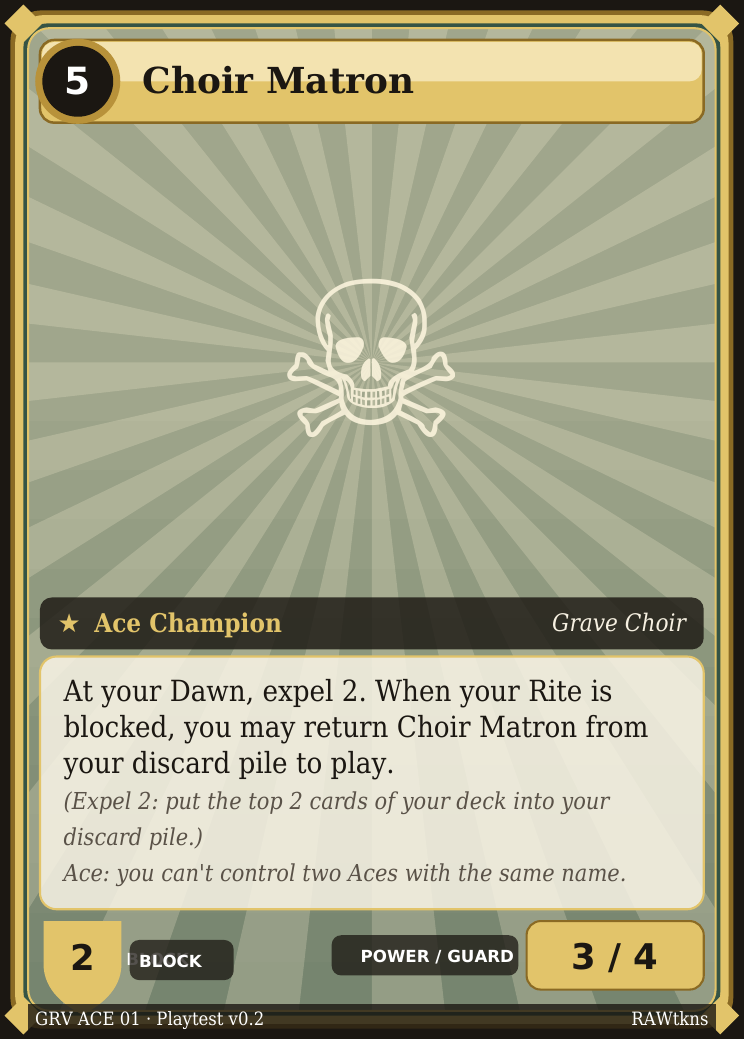
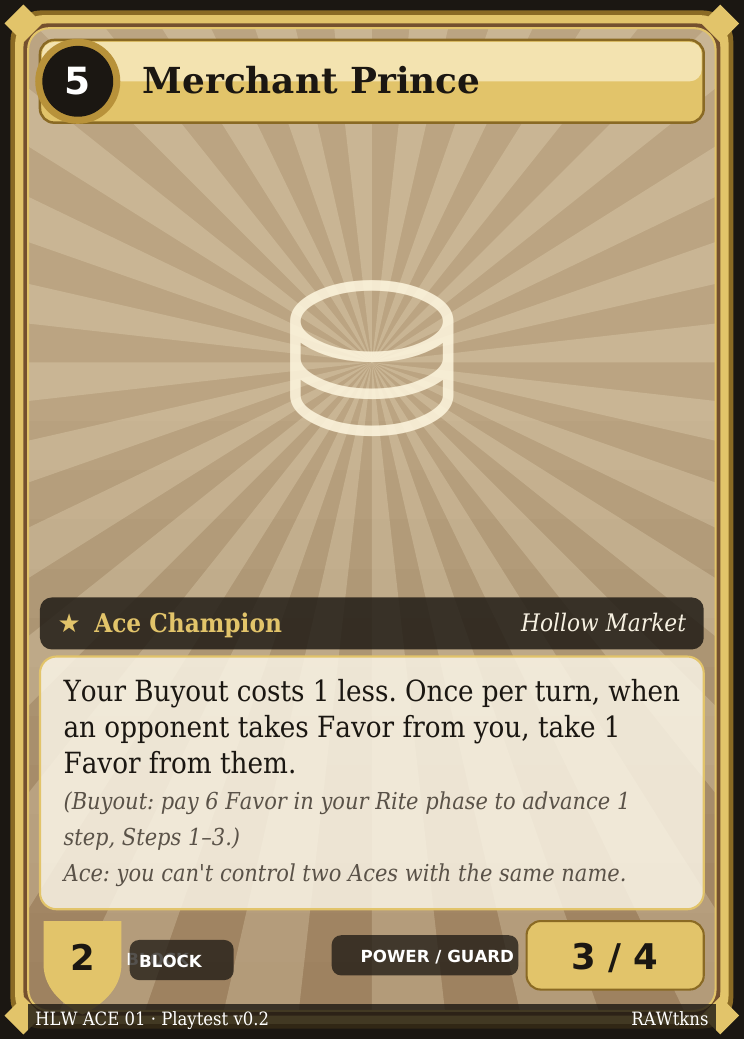
- Ace Champion
- A Crown's gold-framed signature Champion. You can't control two with the same name.
- Reminder text
- Small italic text in parentheses. It only reminds you of a rule and never changes it.
- Leader
- The player furthest along the step track. If players are tied, "the leader" on a card means one of them of your choice. (Threat only applies to a player alone in the lead.)
Setup
- Lay out your Crown and Rites. Place your Crown card and lay out your 5 Rite cards face up in order.
- Start at Step 0. Every player's marker starts on Step 0 of their track.
- Draw 6. Shuffle your main deck and draw 6 cards. Once, at the start of the game, you may mulligan: shuffle those 6 back and draw 6 new ones.
- Pick a first player. Choose at random. Play goes clockwise.
- Starting Favor. Players 1 and 2 start with 0, player 3 with 1, player 4 with 2. This offsets going later.
Turn structure
Each turn has five phases. Any player can play Interrupts during any phase.
Dawn
Ready your Champions, gain 3 Favor (up to your cap), then draw 1 card.Main
Play any number of Champions, Tactics and Pacts by paying their Favor cost.Combat
Your Champions may attack. No Champions, Tactics or Pacts; Interrupts are still allowed.Rite
You may attempt your next Ritual step, at most once per turn.Dusk
Discard down to 7 cards. All damage on Champions clears (except Poison). Pass to the left.Saving Favor matters. Favor only refills on your own turn. Favor you hold back is what pays for Interrupts on everyone else's turns.
Favor cap: you can never have more than 6 Favor (Hollow Market: 7), at any time, on any player's turn. Favor gained over the cap is lost. For example, at Dawn with 5 Favor you gain only 1.
First turn: every player, including the first player, gains Favor and draws at Dawn as normal. Starting Favor already offsets going later.
Combat
Champions only fight other Champions; there are no attacks on players. The point of attacking is to strip Guard away from a Rite before it hits the Altar.
Attacking (during your Combat phase)
- Declare all attacks at once. For each Champion you attack with, choose one target: a Champion controlled by any opponent. Several of your Champions may pick the same target, or you can split them across targets and opponents.
- Engage your attackers. A Champion can attack once per turn.
- Interrupt window. Any player may play Interrupts (for example, Iron Wall cancels the whole attack on one Champion; Scorched Ground lowers an attacker's Power).
- Resolve each fight. The attackers deal damage to the target equal to their total Power.
- Strike back. Every target strikes back once, whether or not it was destroyed. The defending player chooses which attacker it hits, and deals damage equal to the target's Power.
Combat rules
- No defending Champions. The defender can't move another Champion in to protect the target. Only Interrupts can stop an attack.
- Damage: damage on a Champion adds up. When its total damage is equal to or greater than its Guard, it's destroyed. Card damage works the same way as combat damage.
- Damage clears at Dusk, so there's nothing to track between turns. The exception is Poison: damage from a Poison Champion stays until the damaged Champion leaves play.
- New Champions can't attack the turn they're played unless the card says so (Flame Herald). They can still be attacked, and still add +1 Ward.
- Attacking costs you defense. An engaged Champion doesn't add its +1 Ward to your Rite this turn.
- Group kills: "When [this card] destroys a Champion" effects (Cutpurse) trigger for every Champion in the attacking group.
- Strike back isn't an attack. Champions that "can't attack" (Bastion Golem, Castle Guard) still strike back.
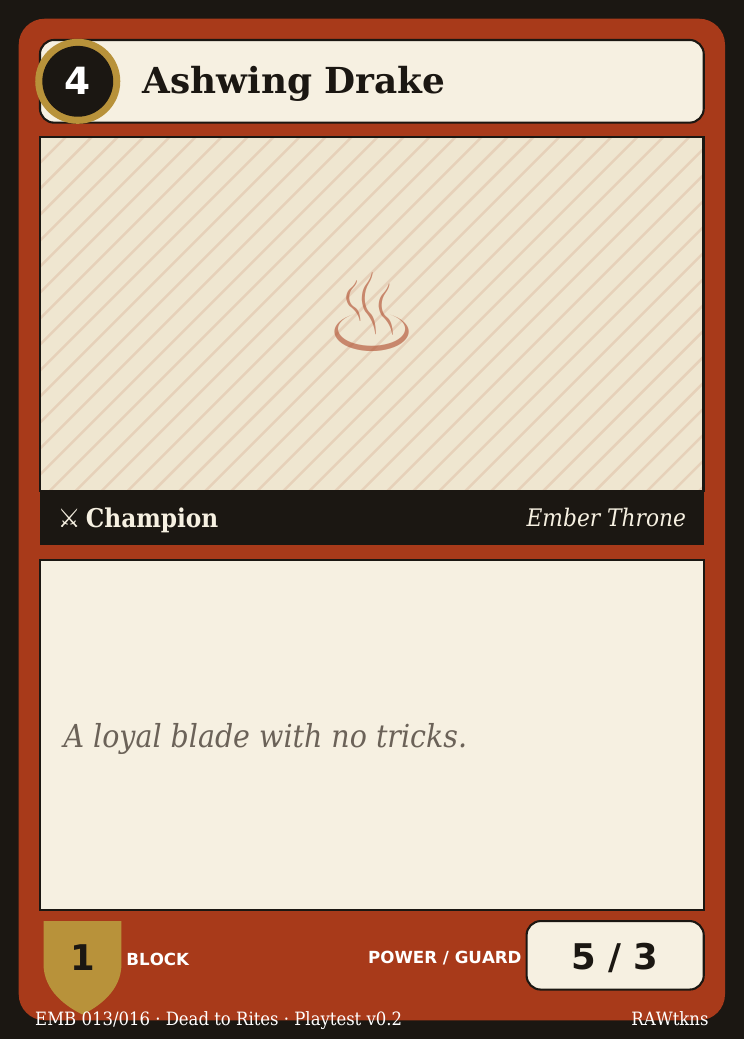
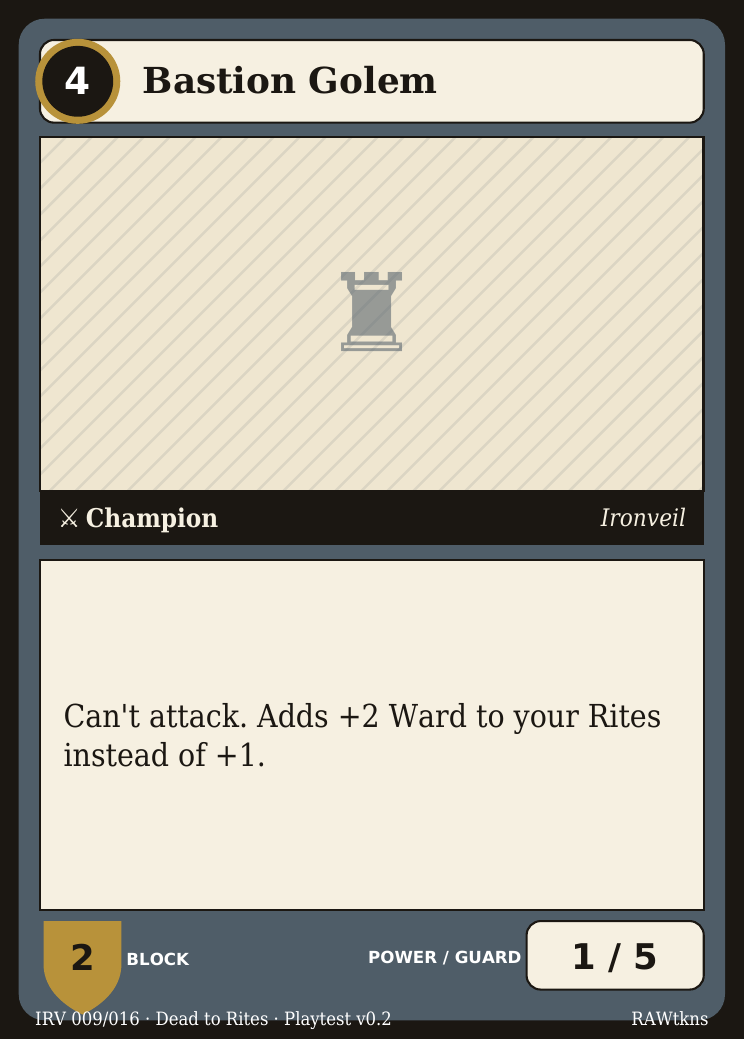
The Ritual track
To advance, pay your next Rite's cost and place it on the Altar. It resolves only if the other players fail to block it.
| Step | 1 | 2 | 3 | 4 | 5 |
|---|---|---|---|---|---|
| Favor cost | 1 | 2 | 3 | 4 | 5 |
| Ward (Block needed to stop it) | 2 | 3 | 5 | 6 | 8 |
- Threat (leader tax): if you're alone in the lead on the track, your Rite costs +1 Favor.
- Champion Guard: each of your ready Champions adds +1 to your Rite's Ward, whatever its Guard. Engaged Champions don't count. Destroying the leader's Champions makes them easier to block later.
- Crowning: when a Step 4 or 5 Rite hits the Altar, every other player draws 1 card before responding.
- Completed Rites: a resolved Rite goes face up on your Completed pile, newest on top. Your step always equals the number of Rites in that pile.
- Rite bonuses: each Crown's Steps 1–4 give a small bonus while that Rite is in your Completed pile. Step 5 has no bonus: resolving it wins the game.
Rite bonuses for every Crown
| Crown | Step 1 | Step 2 | Step 3 | Step 4 |
|---|---|---|---|---|
| Ember Throne | Spark: your first Champion each turn costs 1 less | Kindling: your Tactics cost 1 less (min 0) | Blaze: your Champions can attack the turn they're played | Wildfire Crown: your Champions get +1 Power |
| Ironveil | First Stone: your Champions get +1 Guard | Iron Oath: when one of your Champions is destroyed, gain 1 Favor | The Bulwark: your Champions strike back with +1 Power | Unbroken Gate: opponents' cards that destroy your Champions cost 1 more |
| Whisper Syndicate | First Whisper: once per round, peek at one face-down card in the Defense Pool before it flips | Ledger of Names: gain 1 Favor whenever a Rite you helped block fails | Silent Pact: the first card you commit to each Defense Pool counts +1 Block | The Unseen Hand: opponents' Interrupts cost 1 more |
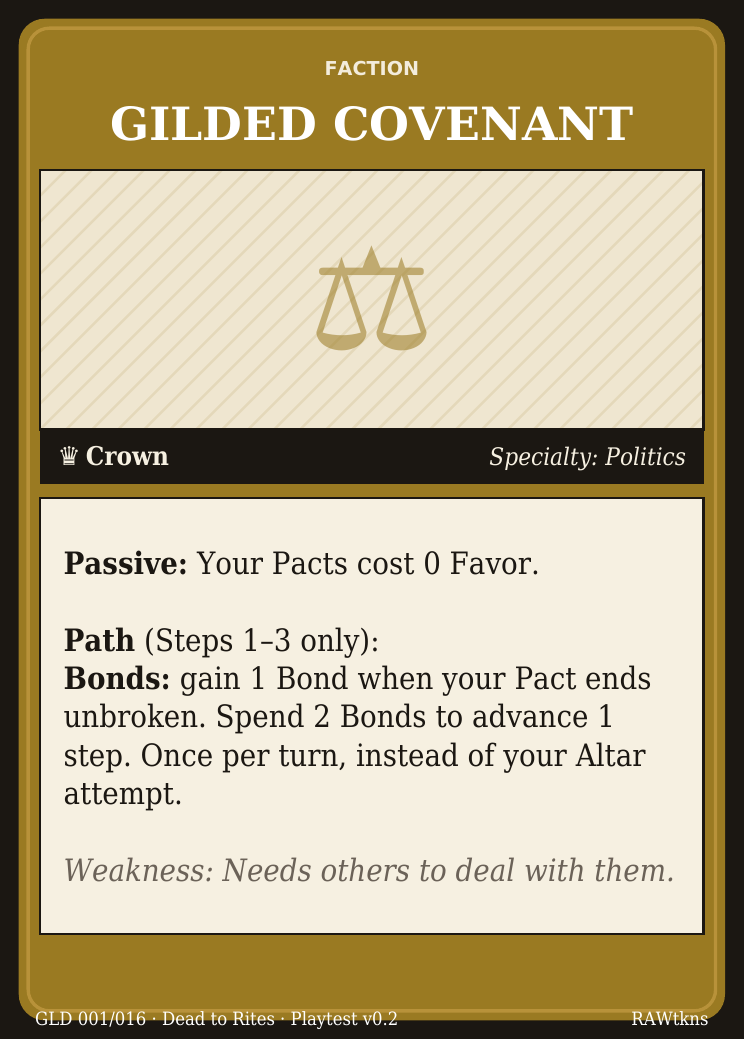
| Gilded Covenant | Opening Offer: when a player accepts your Pact, gain 1 Favor | Sealed Contract: players in an active Pact with you can't attack your Champions | Golden Ledger: at your Dawn, gain 1 Favor per active Pact you're in (max 2) | The Grand Bargain: breaking a Pact with you costs 4 Favor instead of 2 |
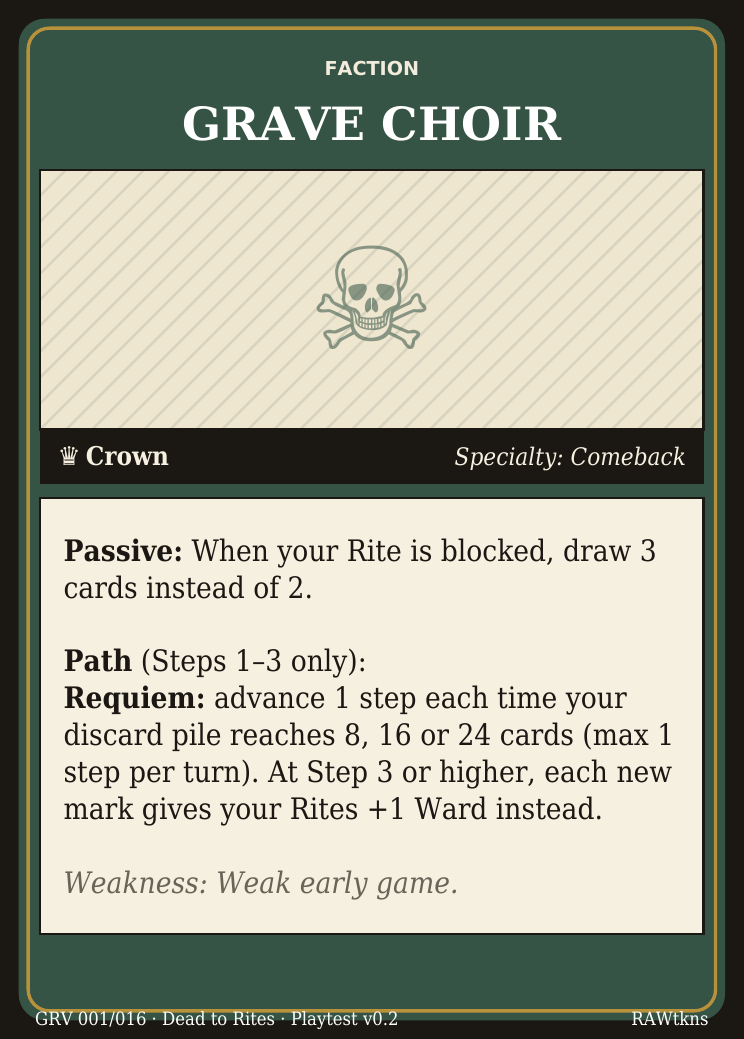
| Grave Choir | First Dirge: at your Dawn, expel 1 | Open Graves: once per turn, play a Champion from your discard pile for +2 Favor | Choir of Bones: when your Rite is blocked, also return a Champion from your discard pile to your hand | The Long Requiem: your Rites get +1 Ward per 10 cards in your discard pile |
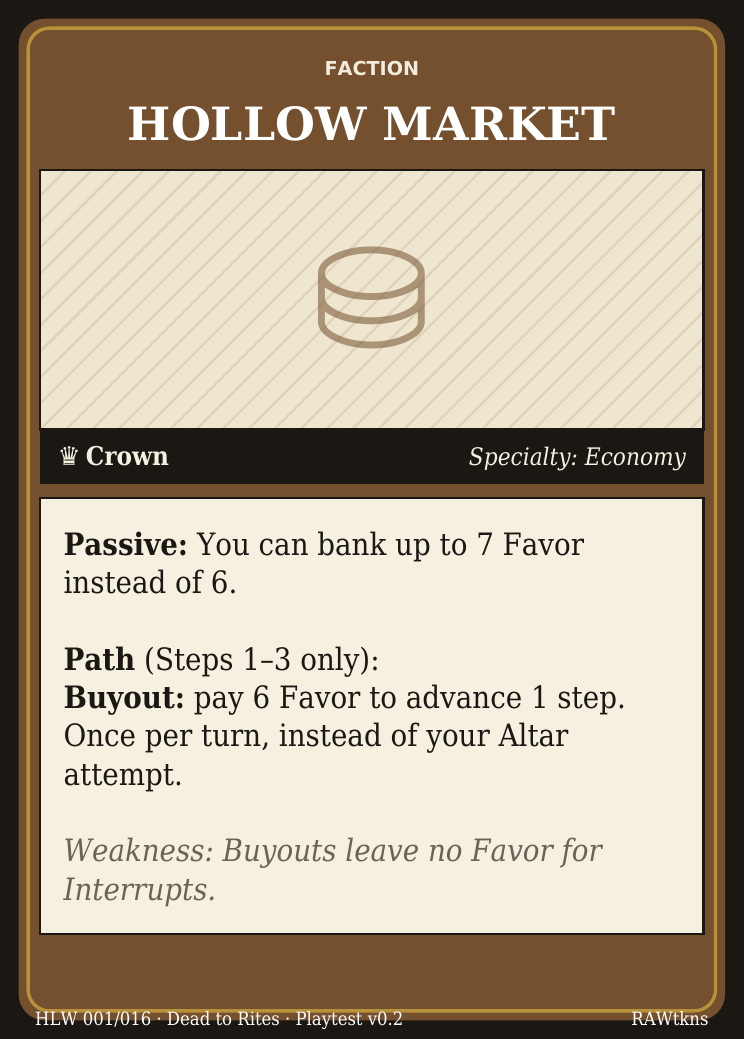
| Hollow Market | First Coin: gain 1 extra Favor at Dawn | Open Ledger: when an opponent takes Favor from you, they take 1 less | The Counting House: at your Dawn, if you have 5+ Favor, gain 1 more | Hostile Bid: once per turn, pay 2 Favor to subtract 1 from the Defense Pool total against your Rite |
Stopping the leader
When a Rite is on the Altar, the other three players pool cards to beat its Ward.
- Commit cards. Starting left of the active player, each opponent may commit any number of cards face down to the Defense Pool, or pass.
- Interrupts. Any player, including the active player, may play Interrupts during this window.
- Flip the pool. Add up the Block values of every committed card.
- Total is equal to or more than the Ward. The Rite is blocked (see below).
- Total is less than the Ward. The Rite resolves and the player advances. Committed cards are discarded either way.
Bluffing: cards go in face down, so you can commit a 0-Block card to look helpful while saving your good ones. Everyone can see how many cards each player commits, but not which ones.
When a Rite is blocked
- The Rite returns to the top of your Rite stack.
- Gain 2 Favor (up to your cap). The rest of the Favor you paid is lost.
- Draw 2 cards (Grave Choir draws 3).
Helped block: you helped block a Rite if you committed at least one card to its Defense Pool, or played an Interrupt that added to the Defense Pool total.
Pacts
Pacts turn table talk into rules. You offer one to a single player, and they accept or decline.
- If they accept, both of you are bound by the card's terms until the end of your next Dawn. Effects that happen "at the start of your next turn" still happen before it ends. The Pact stays face up between you, then goes to your discard pile. If nobody broke it, it ended unbroken (this counts for Bonds).
- If they decline, the Pact goes back to your hand and you get the Favor back.
- Breaking a Pact is allowed: you break it by acting against its terms. The breaker loses 2 Favor, the other player draws 2 cards, and the Pact goes to the discard pile.
- "Can't" on a Pact means "agrees not to". You can still do it, but doing it breaks the Pact (unless a card like Arbiter of Oaths says Pacts can't be broken).
- Verbal deals outside Pacts are allowed but never binding.
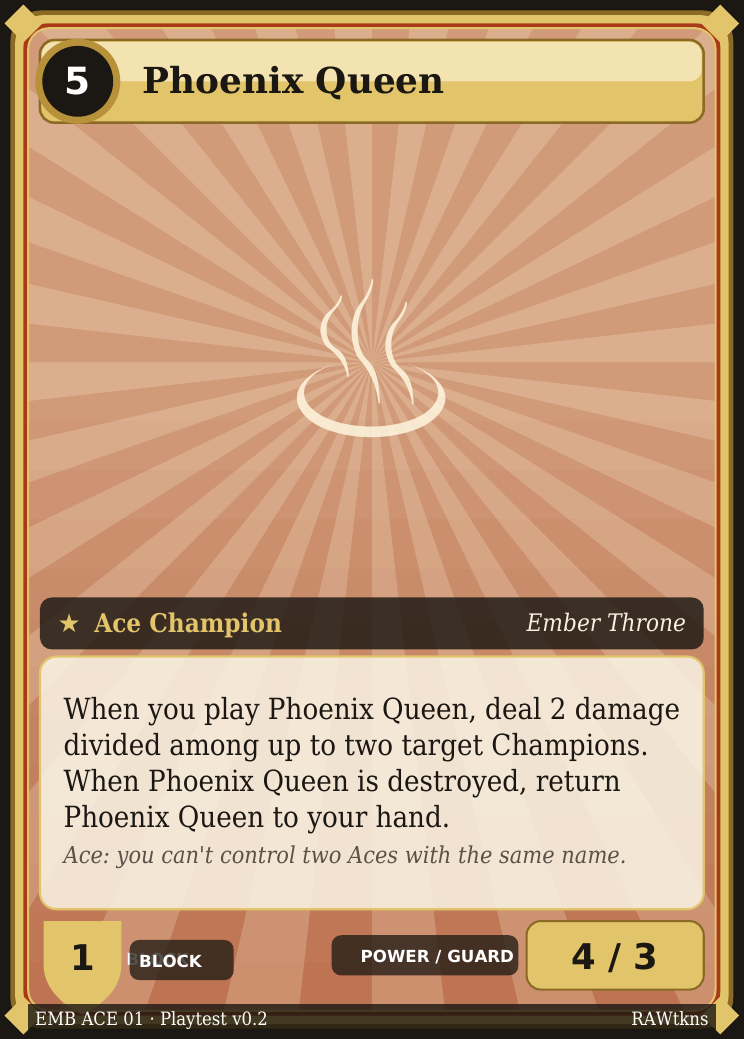
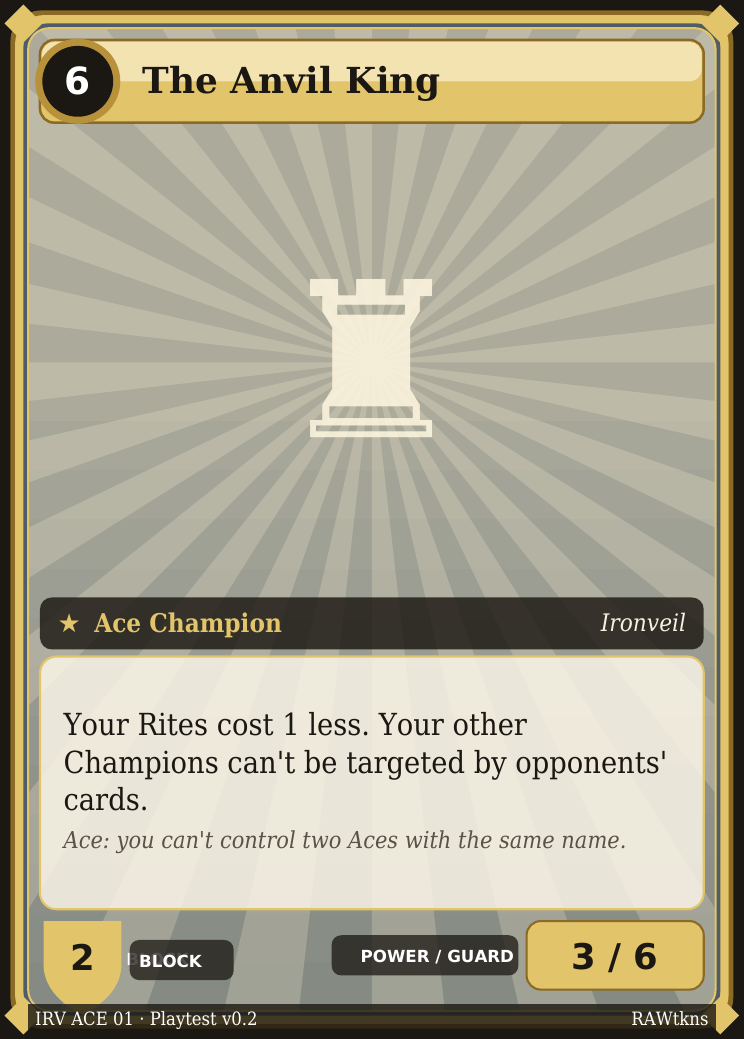
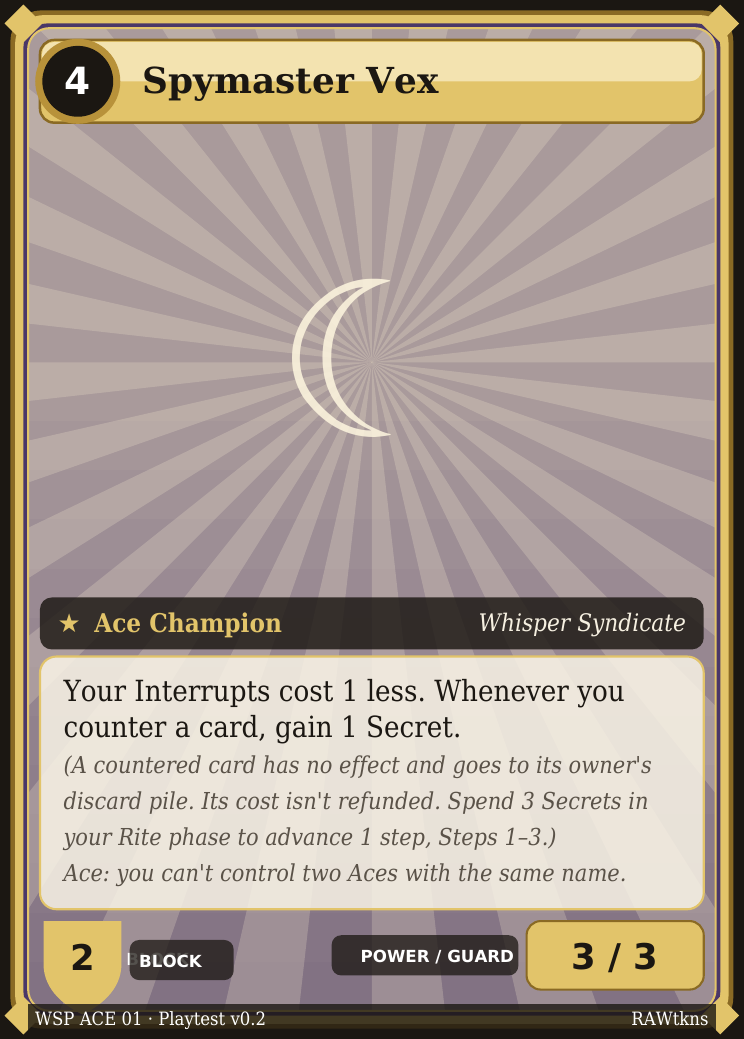
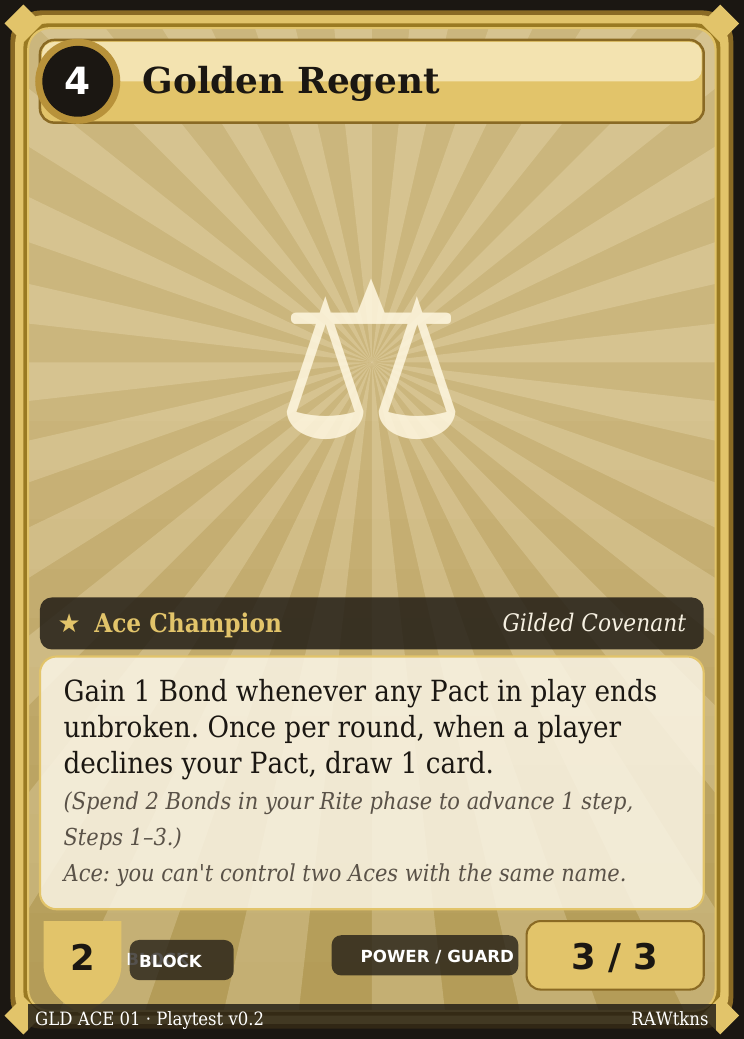
Ace Champions
Ace Champions are signature Champions with full art and a gold frame. Each Crown's starter deck has one.
- One of each name: you can't control two Aces with the same name, but you can control several different Aces. If an Ace would come into play while you already control one with that name, you can't play it (or return it to play).
- The limit is per player: an opponent can control their own copy of the same Ace.
- Otherwise an Ace is a normal Champion: it attacks, strikes back, adds +1 Ward and can be destroyed.
The six Crowns
Each Crown excels at a different part of the game. Any player may pick any Crown, even if all four pick the same one.
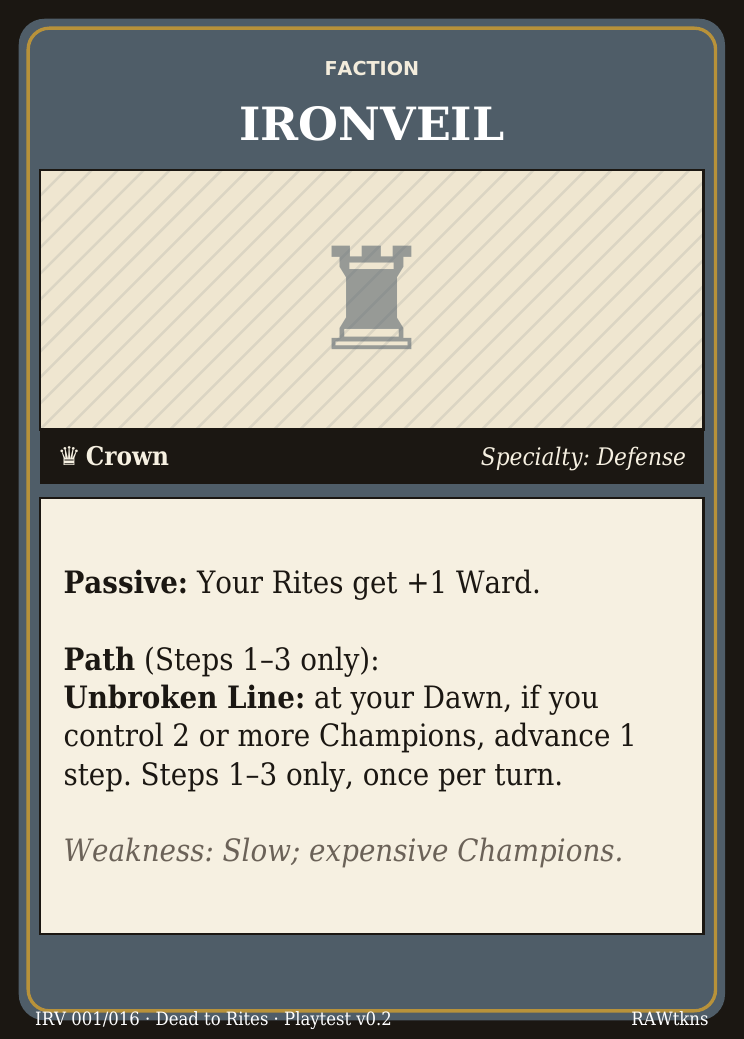
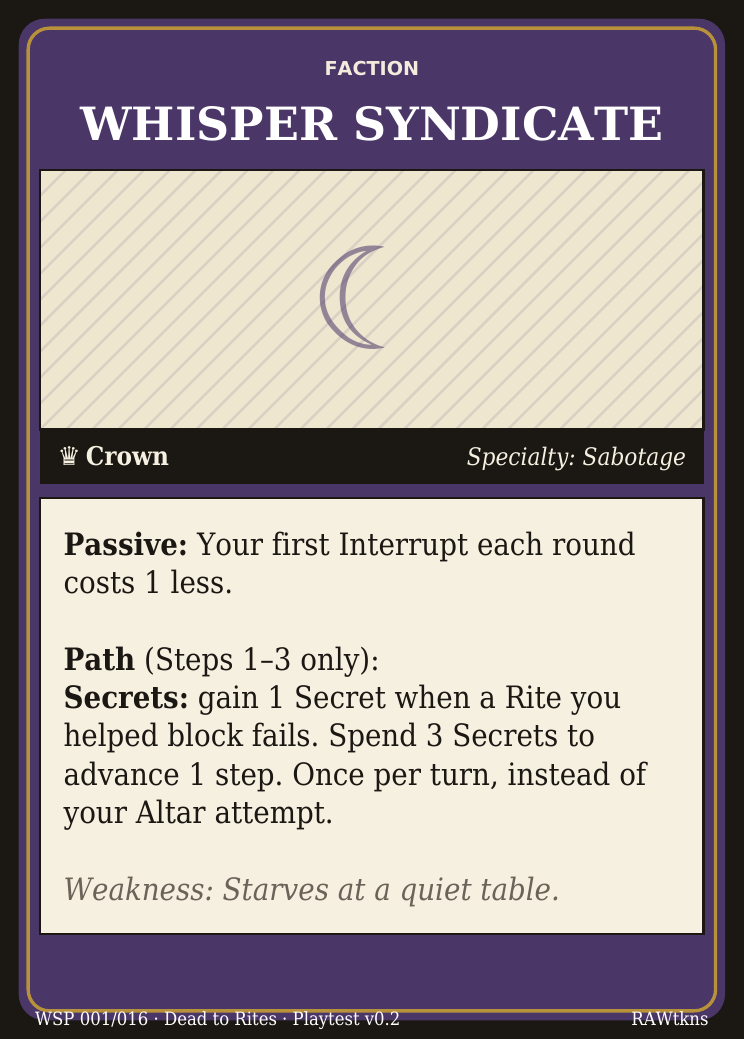
Path rule: each Crown has a Path, its own way to advance without the Altar. A Path can only advance you through Steps 1–3. Steps 4 and 5 must always go through the Altar.
| Crown | Specialty | Passive | Path (its own way to advance) | Weakness |
|---|---|---|---|---|
| Ember Throne | Speed | Rites cost 1 less Favor | Wildfire: once per game, attempt two Rites in one turn | Low-Block cards; poor at helping block |
| Ironveil | Defense | Rites get +1 Ward | Unbroken Line: at your Dawn, if you control 2 or more Champions, advance 1 step (max 1 step per turn) | Slow; expensive Champions |
| Whisper Syndicate | Sabotage | First Interrupt each round costs 1 less | Secrets: gain 1 Secret when a Rite you helped block fails; spend 3 to advance (once per turn) | Starves at a quiet table |
| Gilded Covenant | Politics | Pacts cost 0 Favor | Bonds: gain 1 Bond when your Pact ends unbroken; spend 2 to advance (once per turn) | Needs others to deal with them |
| Grave Choir | Comeback | Draw 3 when your Rite is blocked (not 2) | Requiem: advance 1 step each time your discard pile reaches 8, 16 or 24 cards (max 1 step per turn). At Step 3 or higher, each new mark gives your Rites +1 Ward instead | Weak early game |
| Hollow Market | Economy | Bank up to 7 Favor (not 6) | Buyout: pay 6 Favor to advance 1 step (once per turn) | Buyouts leave no Favor for Interrupts |
Timing and details
Path advances
Interrupts resolve newest first
Wildfire
Empty deck
Rounds and "once per round"
Where cards go
Not enough Favor
Costs, conflicts and simultaneous effects
Costs can't go below 0. Apply every cost increase and reduction, then treat anything below 0 as 0.
The card wins. If a card's text contradicts these rules, follow the card.
Several things at once. If several effects happen at the same time, the active player chooses the order.
Bribe: X can't be more than 4.
Public information
Deck building
- 40 cards, at most 3 copies of any card, plus your Crown's 5 Rites kept separately.
- Only your own Crown's cards and Neutral cards. Cards from another faction can only be played under that faction's Crown.
- Every Crown has a ready-to-play starter deck: 28 Crown cards (9 cards ×3 plus 1 Ace Champion) and 12 Neutral cards. The starter decks on this table are the v0.2 lists.
Using this table
The online table is a sandbox: it doesn't enforce rules. Players move cards and adjust their own counters, just like at a real table, and the log records everything.
| To do this | On the table |
|---|---|
| Draw your opening hand | Draw opening hand. To mulligan, click your deck and choose Mulligan. |
| Set starting Favor | The + and − on your tracker card |
| Dawn | Dawn readies your Champions, adds 3 Favor up to your cap and draws 1. Add any extra Dawn effects yourself. |
| Play a card | Drag it from your hand, or click it for options |
| Engage or ready a Champion | Hover over it and press E, or click it |
| Damage and Poison | Click the Champion and adjust its damage or Poison |
| Attempt a Rite | Drag your top Rite onto The Altar and lower your Favor by its cost. The Altar shows the Ward from the printed value plus your ready Champions. |
| Block a Rite | Drag cards into the Defense Pool (they go in face down), then Flip all |
| Finish the Rite | Resolved ✓ moves it to Completed and sets your step. Blocked ✕ returns it to your Rite stack. |
| Dusk | Dusk clears damage (Poison stays). Discard down to 7 yourself. |
| Expel, search or look at the top of your deck | Click your deck |
| Show everyone your hand | Reveal hand |
| Roll a die, start a new game, change your name | The ⋯ menu in the top corner |